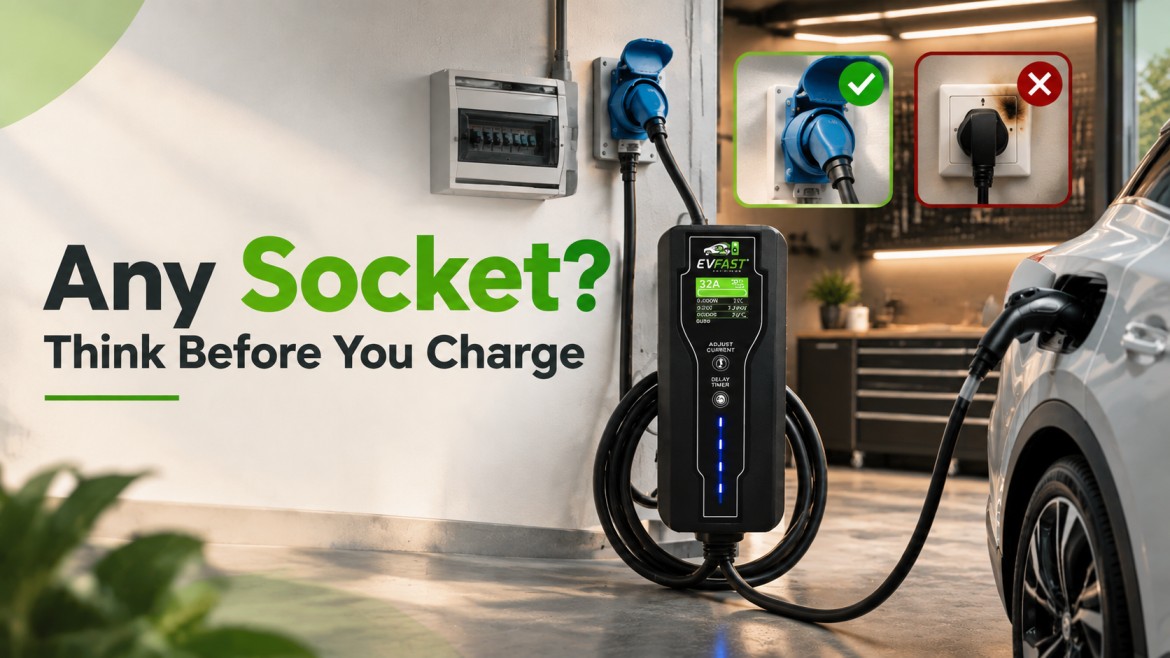
No, you should not plug in an EV charger in any random socket at home. The socket, wire, earthing, protective devices, and available electrical load must have to match the specification of the charger. A well-planned EV Charging Station For Home is not only about having a nice socket near the parking area. The socket behind the charger needs to be able to sustain the electricity for long duration (charging)
This is especially true since the EV charging can put continuous current draw for several hours on a circuit. A socket, which works like a charm for a regular home appliance, may not necessarily be suitable for use with an Electric Vehicle Charger.
Why The Socket Rating Matters
Home sockets are designed for certain current ratings.
If the portable charger requires a higher current than the socket and circuit combination can safely allow for, using an incorrect connection could cause overheating, disconnection, damaged plugs or other electrical issues.
As such the first consideration should never be
"Will the plug fit?"
But rather
is the electrical point rated for the charger?"
For example, the EVFAST 7.4kW Portable EV Charger allows current up to 32A. EVFAST recommends a 32A three pin industrial socket for the 7.4kW, and not a standard domestic socket. A charger with a lesser power output may have different requirements. Always check the requirements of the charger you are using not the ones of a similar charger.
The Wiring Behind The Socket Is Just As Important
You cannot judge a charging point only by a wall socket.
The cable which will be placed behind it should be able to carry the required amount of electricity.
An electrician must check the core, circuit length, connections, breaker power, and existing cable condition before he/she decides to install an EV Charging Station For Home .
For instance, EVFAST, for its 7.4 kW portable model recommends a three-core 6 sq. mm pure copper cable with 32A industrial socket.
It is suitable for the described product, but another one, for example, may require different conditions. The rule of thumb is matching the electrical installation to the charging station.
Why Earthing Cannot Be Treated As Optional
Proper Earthing is one of the most critical aspects of EV charging.
An EV is connected to the power supply for extended periods, usually while parked outside or in a basement. The EV charging station thus requires a reliable protective earth path.
India's Central Electricity Authority safety requirements include residual-current protection, dedicated charging circuits, and earthing provisions for EV charging points. The standards also require systems that disconnect the supply in the event of a loss of effective earthing.
EVFAST also specifies that proper earthing is mandatory for its 7.4 kW portable charger.
Thus, it is recommended that if you are planning an EV Charging Station For Home, a check of earthing should be carried out before commencing regular charging.
Do You Need A Separate Circuit For EV Charging?
In some cases, a dedicated circuit is a better choice.
The Central Electricity Authority's EV safety requirements state that each charging point should be supplied via a dedicated final sub-circuit with appropriate over-current protective devices.
This prevents the EV charger and other electrical devices (air conditioning, water heating, and other power tools) from sharing the same circuit.
A dedicated circuit also allows the proper selection of cables, breakers, and other protective equipment for the charger.
EVFAST's 7.4 kW portable unit requires a 40A MCB as per company specifications during installation.
Once again, the proper circuit breaker should be chosen based on the charger and the installation conditions and should be installed by an authorized electrician.
A Portable Charger Still Needs The Right Power Source
The word 'portable' is misleading
A 'Portable EV Car Charger' can be transported from one location to another, but this does not imply that it is safe to use on any socket you can find an connection for.
Imagine going to your aunt's place for lunch and seeing a nifty socket next to her parking spot. You might get tempted to use it as well, but you don't really know what's going on with the wirings, earthing, breaker and so on.
Which is why we say that being portable means being able to move between several locations, not to make your car charging possible in places where an EV wasn't supposed to charge before.
CEA planning documents also make a difference between portable Mode 2 charging cables by stating that they have the required built-in controls and protection and are used for home charging purposes
Those charger protections are great, but won't magic your way out of bad household wirings and turn them into proper EV charging circuits.
What About Voltage Fluctuation?
Voltage conditions can also affect the EV charging.
Some homes have a frequent supply fluctuation.
Depending on the charger and the home’s electrical conditions, additional protection may be required.
EVFAST recommends that users of its 7,4 kW charger consider the use of a voltage stabilizer before the MCB in areas of frequent or extreme voltage fluctuation.
Another reason why an Electric Vehicle Charger installation should be based on the property in question and not simply copied from another home is because the charger, the vehicle, the supply, and the infrastructure have to work together in harmony.
What Should You Check Before Charging An EV At Home?
Before undertaking regular charging, it is vital to ensure that the proposed point has been checked by the relevant authorities for the following:
a) The socket is appropriate for the current drawn from the charger;
b) The wiring is appropriately rated;
c) There is proper earthing;
d) There is suitable circuit protection;
e) The charger has a supply circuit where necessary;
f) Connections, and sockets, are in sound condition;
g) There is available capacity on the property’s electrical supply to meet the demand from the charger;
h) The charger is installed in compliance with the manufacturer’s installation instructions, and relevant electrical standards.
The Ministry of Power’s 2024 EV charging guidelines apply to private parking as well as public and semi-public places and aim to promote the safety and efficiency of all charging processes.
Building A Safer EV Charging Station For Home
At EVFAST, besides choosing the right charger, there are few more things to consider.
EVFAST provides portable EV chargers apart from industrial sockets, socket boxes, protective equipment, and accessories for charging. The 32A Industrial socket box comes with a 32A socket and a 40A MCB making it fit for compatible portable EV charging purposes.
While making the choice of the charging point for your personal vehicle, it becomes essential to finalize the electrical point prior to the regular use of a charger.
It may not be advised to go with the nearest socket to your vehicle.
A properly designed charging point must be chosen according to the input requirements of the charger you are planning to use.
Final Thoughts
An EV charger cannot be treated as just another household appliance.
A proper EV Charging Station For Home requires the correct socket, wiring, earthing, circuit protection and capacity.
A Portable EV Car Charger can offer you flexibility, but makes sure you have the appropriate power supply.
So, before plugging in your EV for an overnight charge, make sure you consider more than the simple fit of the plug.
Frequently Asked Questions
1. Can I Plug My EV Charger Into A Normal Home Socket?
It depends on the charger. Some lower-power portable chargers may be designed for compatible domestic or industrial sockets, while higher-current chargers need dedicated electrical points. Always follow the charger's specified input requirements.
2. Does A 7.4 kW EV Charger Need A Special Socket?
EVFAST specifies a 32A three-pin industrial socket for its 7.4 kW portable charger, along with suitable wiring and protection. Other products should be installed according to their own specifications.
3. Why Is Earthing Important For An Electric Vehicle Charger?
Earthing provides a protective path during electrical faults. Indian EV charging safety requirements include specific provisions for earthing and residual-current protection.
4. Can I Use An Extension Board For EV Charging?
Do not assume a household extension board can handle EV charging. Charging can create a high continuous load. Use only connection methods specifically approved for the charger and installation.
5. Does A Portable EV Car Charger Work At Any Location?
Not automatically. The location still needs a compatible socket, suitable wiring, earthing, protection, and adequate electrical capacity.
6. What Should I Check Before Installing An EV Charging Station For Home?
Check the charger rating, socket type, cable size, earthing, circuit breaker or other required protection, available electrical load, parking location, and the manufacturer's installation instructions. A qualified electrician should assess the electrical setup before installation.