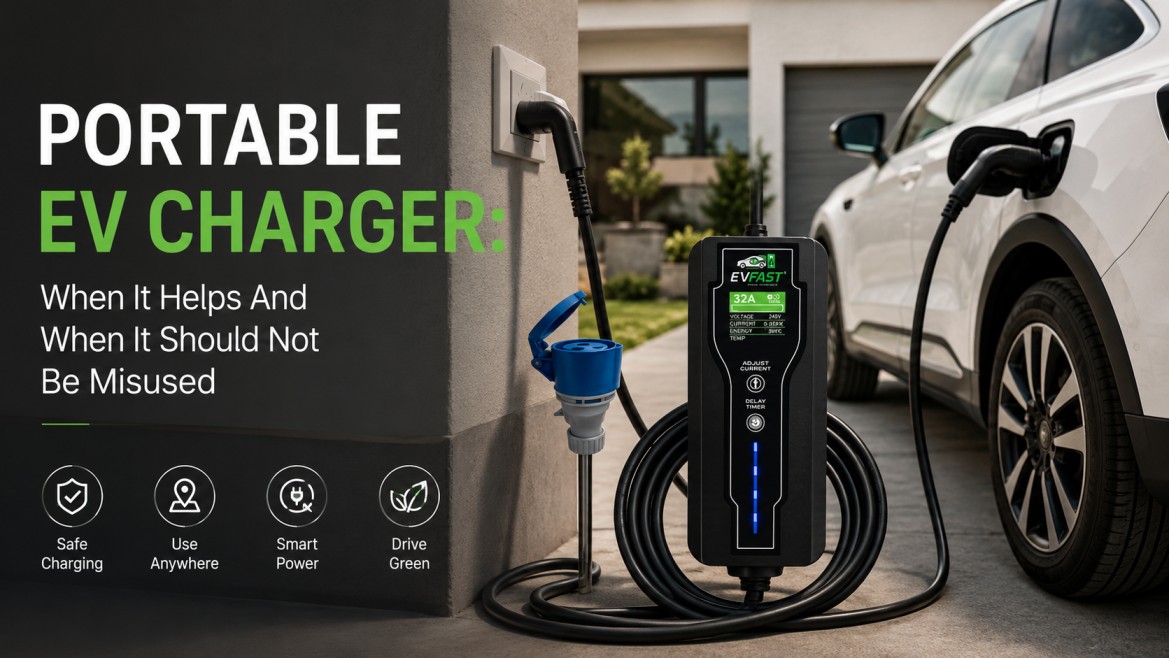
A portable charger for an electric vehicle sounds quite straightforward. Store it inside the car, plug it in whenever necessary, and charge the electric vehicle where there is any power source.
For most owners of electric vehicles, it is a huge relief indeed. It makes them feel secure while traveling, parking in offices, charging at homes or during emergencies. However, there is one thing which all users of electric cars must know without any doubts. The portable charger for an electric vehicle becomes useful only when used in the appropriate power arrangement.
Under no circumstances should it be considered just another charger for phones. The electric vehicle charger carries much more load. Hence, the socket, cable, earthing and power source become extremely important. Any deficiency in the arrangement might result in heating, tripping or low charging.
Where A Portable EV Charger Helps
A portable EV charger is useful when one requires charging convenience. For instance, there is no dedicated wall charger at the person’s disposal. The user could also be moving between two different places and would require charging from the other place. Some individuals might use it at their office parking space, farmhouse or rental accommodation. In such situations, a portable EV car charger provides more flexibility.
Another situation where a portable charger is useful is when it acts as a secondary choice. It means that when the user is unable to find the regular charging source, the portable charger could provide the required charge for the journey. This does not imply that it should be connected to any port without considering its suitability for EV charging.
Why The Power Point Matters
Most of the charging troubles start at the plug point. Loose socket, faulty wiring, bad earthing, and over-loaded wire can cause trouble when charging.
The charging will be fine for some time. But the socket becomes very hot. Sometimes the MCB keeps tripping. It is not always the trouble with the charger. Sometimes the existing power arrangement is not suitable for the EV load.
Before plugging in an EV charger, the user needs to check whether the socket can bear the load or not. The wiring is okay or not. The earthing must be proper. The plug must fit tightly in the socket. The charger does not swing freely from the socket.
Do Not Depend On Cheap Extension Boards
This is probably the most frequent mistake. Individuals prefer to make use of ordinary extension boards since the parking spot is far from the electrical socket. It may seem more convenient at first sight, however, it is quite dangerous. Ordinary extension boards are not designed to handle prolonged load for charging electric vehicles. The board could possibly overheat, melt, or break down during operation. Loose contacts could damage the charger plug.
In case an extension is necessary, it must be robust and appropriate for the charger load. But in any case, it is better to charge directly through the correct socket. Using the portable charger is quite flexible but does not mean it is completely safe.
When A Portable Charger Should Not Be Misused
A portable EV charger must never be used when the sockets, wiring arrangements, overload of plug points, or earthing is not done properly.
Moreover, it must not be used where there is any possibility that the charger or plug may get wet from water, mud, or loose dust particles. Charging during rain might be safe provided that the charger and all other equipment like connectors, sockets, and protection arrangements have been made for this purpose. However, the user should always keep the plug covered and never place the charger in such a way that it collects any water.
Furthermore, a portable charger should never be turned into an improper jugaad arrangement. For regular charging of your vehicle at home, it would be better to arrange a proper EV charging point.
It Is Useful For Home Charging Too
The use of the portable ev car charger will be useful in your home as long as your system at home is set up.
This is due to the fact that most people love it due to its portability. It is perfect for those who travel within a short distance daily without requiring a charging station straight away.
However, the rule is still the same even when at home. There needs to be a sturdy socket. The wires need to be checked. Also, there should be no connection of the charger on a fragile board.
Portable Charger Or Fixed Charger?
Each serves a different purpose. For frequent charging in one place, a fixed EV charger works best. It creates a neat system and is easy to use daily.
A portable EV charger works well for flexibility. It can help during travel, backup charging, alternate site charging, or occasional use. Choosing a type depends on driving patterns.
When an EV needs to be charged at home every night, a fixed system will work better. If the user frequently travels or charges in different locations, a portable charger comes handy. A lot of EV owners prefer having both types.
What EV Owners Should Check Before Buying
Do not consider the price of the portable charger before purchasing it. Consider charger ratings, plug types, safety of the charger, cable quality, connector quality, guarantee, and customer support services. Consider the compatibility of your car with the charger output too. An ideal ev car charger must be safe to use, user-friendly, and durable enough to handle real-life scenarios.
EV Fast is all about offering convenient EV charging experience to Indians. Regardless of the purpose of the portable charger – travel, home, or backup, safe charging must always be the main aim.
Final Thoughts
An EV portable charger is probably one of the most helpful accessories for an EV owner. It offers independence. It eases anxiety about range. It assists in travels and back-up scenarios.
However, it should be employed properly. The charger is only one component of the entire system. The socket, the wiring, the earthing, the quality of the plug, and the place where the charging is done are just as significant.
Use a portable EV charger wherever it can be justified. Misuse it with faulty sockets, low-quality extension boards, or wiring at your peril. That is how EV charging remains uncomplicated and secure.
Frequently Asked Questions
1. What Is A Portable EV Charger?
A portable EV charger is a charging device that can be carried and used at suitable power points. It helps EV owners charge their vehicle at home, during travel, or at another safe charging location.
2. Can I Use A Portable EV Charger At Home?
Yes, you can use it at home if the socket, wiring, earthing, and power supply are suitable for EV charging. A weak or loose socket should not be used.
3. Is A Portable EV Car Charger Safe?
Yes, it can be safe when used with the correct power setup. The charger should not be connected to damaged sockets, poor wiring, or cheap extension boards.
4. Can I Use A Normal Extension Board For EV Charging?
No, normal extension boards are not recommended for EV charging. They may heat up or fail under long charging load. A proper EV charging point is always safer.
5. When Should I Use A Portable EV Charger?
You can use it for home charging, travel charging, backup charging, second-location charging, or occasional charging where a suitable power point is available.
6. Is A Portable Charger Better Than A Fixed EV Charger?
It depends on use. A fixed charger is better for daily charging at one place. A portable EV charger is better for flexibility, travel, and backup use.